
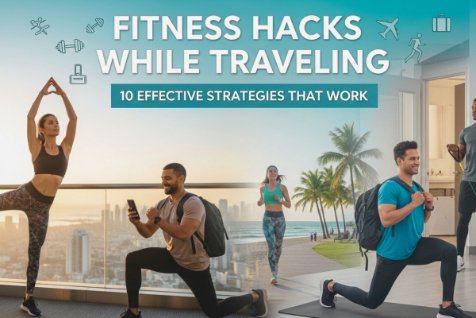
Let’s face it — travel is exciting but when you’re away from home, it’s also one of the biggest enemies to your fitness routine. Late flights, heavy meals, long layovers and no access to a gym can throw even the most dedicated of athletes off kilter. But here’s the bright side: with the best fitness tips for travelers, you’re more than able to stay active, feel energized and keep your body in tip-top shape no matter where in the world you find yourself.
Whether you’re a frequent business flyer, a backpacker leaping from one hostel to another, or someone come on vacation for two weeks, this guide covers all the best things to know. These tips are practical, proven, and — perhaps most importantly — actually possible on the road.
How to Stay Fit While Traveling — (And Why It’s So Hard But Totally Worth It)
Before getting into the tips, we can at least recognize the struggle. Travel messes up your sleep, throws off your diet and wrecks your schedule. Research indicates that just a few days of inactivity can begin to compromise muscle strength and cardiovascular fitness. And with time zones, tight itineraries and the unpredictability of unfamiliar food, exercise is often the first thing to give.
But here’s what this means: maintaining your activity levels while traveling, reduces jet lag, enhances your mood, boosts immunity and keeps up the energy levels so you to enjoy your trip. Fitness isn’t only about how you look — it’s how you feel, especially when you’re away from home.
“Travelers who stick to even low-intensity exercise routines report higher happiness levels and better sleep quality while away.” — Travel Wellness Research, 2024
10 Travel Fitness Tips You Should Know
01. Pack Your Workout Gear (Even If It’s Minimal)
The most underrated fitness tip for travelers is to pack the right gear. You don’t need an entire gym bag — just the necessities:
A simple pair of running shoes
Resistance bands (these feel like they weigh about a pound)
A compact jump rope
Moisture-wicking workout clothes
If you’ve got your gear at the ready, there’s no excuse. An entire gym session can be had with resistance bands alone — rows, squats, presses and bicep curls are portable.
02.Master the Hotel Room Workout
You don’t need a gym. Your hotel room is your gym. A decent 20–30 minute bodyweight circuit can support your entire trip’s fitness requirements.
Try this quick routine:
20 push-ups
30 squats
15 tricep dips (on bed or chair)
20 lunges per leg
1-minute plank
Repeat 3 rounds
No equipment. No commute. Just 25 minutes and your bodyweight. This is one of the most effective fitness tips for travelers — and the simplest.
03.Walk Everywhere You Possibly Can
Walking is deeply underestimated as a workout. Swap taxis and Ubers for your own two feet when safe and practical: Suburban jetsam can be found everywhere.
Try to walk at minimum 8,000–10,000 steps daily. You’ll burn some calories, see the city organically and ease the guilt about that extra dessert at dinner. Tracking can be a piece of cake if you use apps such as Google Fit, or a built-in step counter on your phone.
Helpful: it is also a means of sightseeing. You’ll find the unpolished gems tourists in taxis never do.
04. Use Fitness Apps and YouYube Workouts
Your mobile phone becomes your coach when you are traveling. Here are some of the top apps for workouts while traveling:
Nike Training Club — Free, hundreds of workouts, no equipment required
FitOn — Ideal for HIIT and yoga anywhere
YouTube — Search “hotel room workout” or “no equipment HIIT” for never-ending free content
Down Dog — Ideal for yoga practice in tight quarters
Download sessions for offline access before you travel — a lifesaver when hotel WiFi is garbage.
05. Eat Healthy Without Stressing About It
Fitness isn’t only about movement — nutrition is half the fight. I also learned one of the best travel tips for fitness around food: it’s called the 80/20 rule — have clean eating 80% of the time, and indulge in local food (without guilt) 20% of the time.
Practical travel nutrition habits:
Have a high-protein breakfast (eggs, Greek yogurt, protein shake) in the morning
Pack healthy snacks — nuts, protein bars, fruit
Before every meal; keep drinking water to prevent binge eating
Opt for grilled foods instead of fried
Cut out alcohol — it dehydrates and sabotages sleep
You don’t need to be perfect. You just need to be mindful.
06. Hydrate — More Than You Think You Should
Air travel is brutally dehydrating. Cabin air humidity can fall to 10–20%, versus the 50% humidity we are accustomed. Intake of water does elevate performance, reduces fatigue, brain fog and muscle cramps.
The rule of thumb: for every hour that you’re in the air, drink at least 500ml of water. Bring a reusable water bottle, and fill it up at every airport water fountain you see.
Once you land, keep drinking. One of the most common reasons that goes into it is dehydration and if travelers feel sluggish, skipping workouts.
07. Fly Wise: Stretch and Move on Long Flights
Being in one position for hours on end is bad news for your body — the hip flexors get tight, circulation suffers and back pain often follows after a long-haul flight. One of the best fitness tips for travelers, as it applies not just to all airplane journeys but also so many other types of travel spaces out there: Consider the plane a movement opportunity.
Every 1–2 hours, practice this exercise in the air:
Walk the aisle for 2–3 minutes
Standing calf raises by the galley
Seated leg lifts (good for hip flexors)
Neck and shoulder rolls to relieve tension
This you can do while sitting down and maybe feeling a little off: Ankle circles to avert blood clots
Nobody cares — flight attendants have seen it all. Do your stretches.
08.Make Sleep a Priority as Though It’s Part of Your Training
Sleep may be the most underrated recovery tool. Bad sleep raises cortisol (your stress hormone), tanks your desire to exercise, and leads to muscle breakdown. And jet lag exacerbates the condition.
Here’s how to safeguard your sleep on the road:
Wear a sleep mask and earplugs — hotel rooms can be noisy
No screens for 45 minutes before bed
Keep the room cool (18–20°C is an ideal temperature)
Use melatonin (0.5–3mg) to regulate your circadian cycle
Set to local time as soon as you arrive — avoid long naps upon arrival
09. Good sleep equates to good workouts, good decisions and a better trip overall.
Research Fitness Options Before You Get There
A bit of planning can take you far. If you haven’t traveled yet, here are 10 minutes of research before:-
Is there a gym or pool at your hotel?
Are there parks or running trails in the area?
Do local yoga studios or fitness classes have drop-in rates?
Is ClassPass here in the city? (It often is — and overseas it works)
Having options removes the friction of “figuring it out” when you’re already dragging from travel. Preparation is probably one of the most underrated fitness tips for travelers.
10. Establish Feasible Objectives — Persistence Rather Than Excellence
Sure, a kale smoothie will keep the gluttony at bay, but here’s the sober truth: you’re not going to be making any serious fitness gainz on the road. And that’s completely fine. Your travel goal should be maintenance — hanging on to what you’ve built, not building.
Work out 3–4 times a week, rather than your typical 5–6. Shorter and more intense is better (20–30 minutes HIIT outweighs a slow 90-minute workout). Track your steps. Eat reasonably well.
Allow yourself to live in the moment during your trip. Fitness is a lifestyle, not a punishment — and travel is one of the great pleasures in life.
Bonus tips for travelers: What can you do on the go?
Here’s a few more quick and uncomplicated habits that make a difference over time:
Always take the stairs over the elevator
Do 10 squats each time you visit the bathroom in your hotel room
Do 5 minutes of stretches morning before touching your phone
How about active tourism: cycling tours, hiking, kayaking, surfing lessons
Book hotel near parks or waterfront: Morning runs made easy
Use layovers in airports to walk around the terminal rather than sitting at the gate
PRO-TIP: Any experience involving active travel — be it hiking to a waterfall, or cycling through a region’s vineyards — makes for stronger memories — AND better workouts than a day in the hotel gym.
The Best Travel Workout Gear (Affiliate Choices)
It pays to invest in good travel workout equipment. Here are some favorites, tried and tested by travelers around the globe:
TheraBand Resistance Bands Set — Light and long-lasting with different levels of resistive strength
Crossrope Jump Rope — Small, weighted and good for cardio in any area
Manduka eKO SuperLite Travel Yoga Mat — Flattens, weighs almost nothing
Hydro Flask Water Bottle — Keeps water cold for 24 hours, approved by most airlines
Garmin Forerunner GPS Watch — Running, steps, heart rate and sleep quality tracking
All of these items fit in a carry-on and take your fitness regime on the road to the next level.
How to Create a Sustainable Travel Fitness Routine
Consistency beats intensity every time. The best-charged travelers aren’t spending two hours a day at the gym when they travel — they’re doing 20–30 minutes of purposeful movement, every single day.
Here is an easy weekly travel fitness framework:
Monday, Wednesday, Friday: 25-minute bodyweight or resistance band workout
Tue/Thu: 30-minute walk or light jog to explore the city
Saturday: Active tourism (hiking, biking, swimming or yoga class)
Sunday: Rest and stretch — your body needs to recover, too
Add this to your travel itinerary, remain flexible and you’ll return home feeling as strong as when you went away.
Final Thoughts
Travel with a fit body all: it isn’t impossible. With these fitness tips for travelers in your corner, you have everything you need to stay active, energetic and healthy — no matter where the road leads.
Start small. Pack your bands. Walk more. Drink your water. Get your sleep. The habits you create on the road are the very same that create a lifetime of health.
Your next adventure should not be the thing that derails your fitness journey — it can help you to carry on with it.
FAQs: Fitness Tips for Travelers
What are the best fitness tips for travelers with no access to a gym?
Whether body weight workouts (push-ups, squats, lunges and planks), resistance band exercises or a daily walk around the neighborhood — are some of the best travel fitness tips for people who don’t have access to the gym. None hotel room workouts need no equipment and take 20–25 minutes to complete. In addition, free workout videos exist on YouTube and apps like Nike Training Club that are tailored to body-weight or no-equipment exercise.
How do I stay motivated to train while traveling?
When you do a thing, motivation comes — not the other way around. Set small goals (like just doing 10 minutes of movement from the start), pack your gear so it’s visible and available and build active tourism into trips to make fitness fun. The bike tours, trekking and swimming qualify for great workouts. Tracking your steps on your phone also forms a rewarding daily habit loop.
What are some fitness tips for travelers around jet lag and making time to work out?
Absolutely. The best fitness tips to combat jet lag: reset your clock immediately by trying to get on local time, expose yourself to sunlight in the morning (it helps reset your circadian rhythm), do low stress exercise (e.g., a 20-minute walk or do some yoga) rather than hard training for the first 24 hours, hydrate, and skip caffeine after 2pm local time. Exercise induces darker states and is critical to 39D. Moreover, light movement actually helps decrease the symptoms of jet lag faster than rest.
What can I eat on the road that will further my fitness goals?
Utilize the 80/20 rule — eat clean, high protein meals 80% of the time and enjoy local food guilt free the remaining. Emphasize protein at every meal (eggs, chicken, legumes, Greek yogurt), pack healthy snacks on the go (nuts, protein bars), drink ample water and reduce alcohol. You don’t have to be perfect — just good enough, consistently so to preserve your energy and muscle while doing it.
Which fitness tips for travelers are most effective long-haul?
The best fitness advice for those taking long-haul flights: Stand and walk the aisle every 1–2 hours, do ankle circles and calf raises to improve circulation, stretch your hip flexors; stretch your neck during the flight; drink 500ml water per hour of flight time; avoid alcohol and salty snacks that will increase dehydration. Compression socks are also a good idea for longer (over 6 hours) flights.