

Is Cardio Before or After Weights More Effective? If you wondering whether cardio before or after weights was more beneficial? Well, there’s no definitive answer as it could depend on a few different co-factors and varies from individual to individual. So what does this mean for your workout session? Let’s break down this theory.” Find out how to balance your workout with 7 better scientifically proven techniques on the order in which you exercise so that they can strengthen it and help you reach closer to aesthetic goals, faster.
If you’ve ever wandered around the gym unsure whether to hit the treadmill first or head right for the squat rack, you’re not alone. The question of cardio before or after weights has been raging for decades — in gym locker rooms, fitness forums and even peer-reviewed journals.
Here’s the good news: science has a tangible answer. And once you know the principles, you’ll never question the order of your workout again. This guide will cover you no matter your goal, whether it be fat loss, muscle building, endurance or general fitness.
- Why Workout Order Actually Matters

You may consider it a trivial detail — warm up, work out, return home. But you do order matters — cardio before or after weights really does impact how your body performs, recovers and adapts.
Now here is what happens in the back of the scene:
Glycogen Depletion: Cardiovascular and resistance training use glycogen (stored carbohydrate) as fuel. Did too much of one first, and you’ll be running on empty for the second.
Neuromuscular fatigue: Cardio can pre-fatigue your muscles, limiting how much you can lift or whether you can lift with proper form.
Hormonal response: Resistance training has a spike in testosterone and growth hormone. And the order can affect how these hormones respond.
Extra Post Exercise Oxygen Consumption (EPOC): Adding weights at the end, can help you with calorie burning even after the workout is over.
Simply put, the first thing you do gets your body’s best energy and freshest muscles. That makes the question of cardio before or after weights a matter of strategy — not just scheduling preference.
- The Argument for Starting With Weights

Most exercise scientists prefer the we-lights first approach, especially for those interested in increasing strength or muscle mass. Here’s why this order seems to make physiological sense.
You’re Stronger When You’re Fresh
It requires muscle recruitment to maximal effort, motor control with precision and mental focus. Beginning with cardio first drains glycogen and exhausts fast-twitch muscle fibers — the same fibers that produce explosive strength and power.
Research indicates that performing cardio prior to weight training can decrease lower body strength performance by as much as 15–20% That matters if you’re attempting to nail a new deadlift PR, or grind through a progressive overloading cycle.
Hormonal Advantage
If you’re doing weight lifting while fresh, it elicits a stronger release of such anabolic hormones as testosterone and human growth hormone (HGH). These hormones promote muscle repair and growth. When you stack cardio afterward, you’re still in that hormonal window — and the extra calorie burn from cardio is just a bonus.
Pro Tip
If hypertrophy is your main object, always do weight first. Save cardio until the end — even 15–20 minutes of moderate-intensity work is sufficient for cardiovascular health without interfering with muscle gains.
- The Argument for Cardio First
There are certain cases in which beginning with cardio before weights is absolutely sensible. And that’s not wrong — it depends what you’re training for.
You’re Training for Endurance Events
Discipline also matters when you are a runner, cyclist, triathlete or swimmer who needs your cardiovascular system primed and aerobic capacity at peak performance. If you’re training for a 10K or marathon, your cardio sessions are the “A” workout — and strength training is auxiliary.
In this instance, it makes sense to do the cardio first. Your legs, lungs, and heart need to be firing on all cylinders during your main training block. The purpose of doing strength work after running is to supplement your run — not substitute for it.
Better Warm-Up for Certain Lifts
Light-to-moderate cardio (5–10 minutes on the rowing machine or brisk walking comes to mind) can actually be an effective warm-up before lifting. It raises your core temperature, increases blood flow to the muscles and primes your nervous system — decreasing injury risk.
The operative word there is light. A 5 min very easy jog is completely different than a hard 45 min interval run. The former prepares you; the latter wears you out.
- What the Research Actually Says
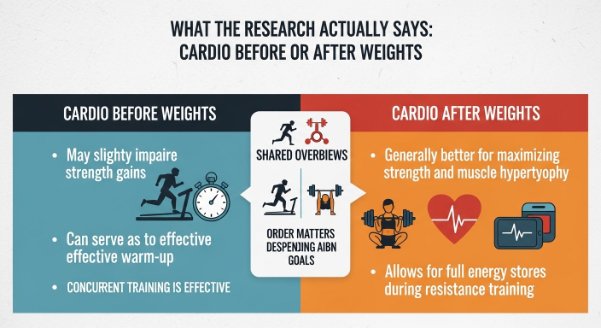
The question of cardio before or after weights is more than just third-hand gym speculation — it has been researched extensively. Here’s a rough outline of what the evidence shows
The question of cardio before or after weights is more than just third-hand gym speculation — it has been researched extensively. Here’s a rough outline of what the evidence shows:
Goal
Optimal Order
Reason
Muscle Building
Weights First
Retains strength, elevates anabolic hormone response
Fat Loss
Weights First
Glycogen depletion from lifting (compared to if you just did cardio alone) pushes body to burn fat during cardio.
Endurance / Cardio Performance
Cardio First
Maximal cardiovascular capacity with full energy stores
General Health & Fitness
Either Order
Consistency matters more than sequence
Weight Loss (Beginner)
Either Order
Total activity volume drives it all
One major academic study published in the Journal of Strength and Conditioning Research found that cardio done prior to weights dramatically negatively impacted strength performance, especially for squat and leg press exercises. In fact, doing weights first had little effect on performance in cardio afterwards.
The conclusion? For the majority weights before cardio is a safer default — but your own goal determines what should come first.
- The Interference Effect: A New Essential for the Muscle Builders

The most critical concept in this conversation is the interference effect — the body’s response to both aerobic and strength training at once, which blunts muscle and strength gains when not applied properly.
Research has shown that steady state cardio, particularly running, can disrupt the molecular signaling pathways involved in muscle protein synthesis on when exercising at a constant intensity. More specifically, it activates AMPK (an energy-sensing enzyme) which has the ability to inhibit mTOR — the major regulator of muscle growth.
So does that mean cardio is killing your gains? Not at all. But it does mean:
Excessive cardio before weights can reduce strength output.
Prolonged Cardio After Heavy pumping Iron Can Extend Recovery
Splitting cardio from weights by a minimum of 6 hours (or on different days) reduces the interference effect – High Quality Evidence
Lower-body cardio (running, cycling) interferes more with lower-body lifting than it does with upper-body work
Pro Tip
If strength training is your priority and you have to do both in the same session, limit cardio during the workout (keep it under 20 minutes) and make it low-impact (e.g., cycling or rowing rather than running) and do it after weights. It helps reduce significantly the interference effect.
- Customizing Your Order to Your End Goal

Let’s make this practical. Here’s one way to organize your sessions, based on what it is that you are trying to accomplish with your training.
Build Muscle & Strength
Weights first, always. Keep post-workout cardio brief and low-intensity. Dig into the compound lifts while you’re fresh — squats, deadlifts, bench press, rows.
Fat Burning & Weight Loss
Weights → glycogen depletion, then steady state or HIIT cardio. Resistance training priming your body to burn more fat.
Improve Cardio & Endurance
Do cardio first when it’s the primary focus of your training. Do weights as an addition to the session or on different days.
General Health & Fitness
Do what you love and are going to stick with Consistency beats perfection every time. Both orders have important health benefits.
Athletic Performance
Focus on the modality that is appropriate to your sport. A sprinter is weights first; a cross-country runner cardio first.
Functional Fitness
Mix it up. Circuit training and functional fitness lends itself to variety — sometimes cardio first warms up your body for movement-oriented workouts.
- The Best Way I’ve Ever Found: Break Cardio and Weights Apart Fully

The truth, which experienced athletes already understand, is the cleanest answer to the cardio before or after weights question is to train them separately.
If you can, splitting your sessions — weights in the morning, cardio at night (or vice versa) — nigh on erases the interference effect and gets both modality its own dedicated energy bank.
This approach is used by:
Competitive bodybuilders that need a breaking stimulator without cardio fatigue
Endurance athletes who run or bike in the morning, strength-train in the afternoon
Hardcore fitness enthusiasts training 5–6 days a week
Can’t split your sessions? Try to have at least 6 hours separating them for partial recovery. Even that tiny gap slashes the interference effect.
If you have to do both in one session? weights before cardio — that’s the evidence-based sweet spot for most training goals.
✦ ✦ ✦
Frequently Asked Questions
Is cardio before or after weights better for fat loss?

For fat loss, in general it is advised to do weights before cardio. Resistance training first depletes your glycogen stores, and here’s why: When you subsequently switch to cardio, your body has less carbohydrate fuel on hand and is compelled to more easily draw off fat stores. According to studies this order can boost fat oxidation during the cardiovascular phase of the session. Weightlifting also elevates your resting metabolic rate, as well as creates an EPOC (afterburn) effect that keeps burning calories for hours after you leave the gym. Combine this with cardio, and you have an effective calorie-torching combo. That said, the key to weight loss is most important thing: consistency — having something you will actually stick with trumps the “perfect” order you abandon after two weeks.
Does doing cardio before/after weights matter for muscle?

Yes, significantly. The downside is that if you perform cardio first, your volume of lifting may be diminished by 15–20%, inhibiting the stimulus to grow your muscles during lifting. This is important, because muscle growth occurs dues to progressive overload — the gradual process of repeatedly challenging your muscles with heavier weights or greater volume over time. When pre-fatigued by cardio, you just cant lift as heavy or as many reps.
To add to the issues, research indicates an effect of “interference” — too much cardio, especially endurance work, activates molecular pathways (via AMPK) that can inhibit muscle-protein synthesizing mTOR signaling. To preserve muscle gains, minimize cardio duration and intensity (do shorter sessions after weights) and prefer low-impact alternatives such as cycling or rowing to running.
What cardio is best to do after weights?

Stationary cycling: Low impact, easy on the joints, good for burning fat
Rowing: Total-body workout without the impact of running
Walking (elevated treadmill): Low impact on muscles but maintains a higher heart rate
Elliptical: Imitates running movement with much less stress on knees, hips
Light swimming: Awesome recovery cardio, full-body aerobic
Try for 15–30 minutes at moderate intensity. Do not do high-intensity interval training (HIIT) right after heavy lifting — your nervous system needs to recover, not receive another stressor.
How long should I wait in between cardio and weights?

If you’re doing both on the same day, try to do them at least 6 hours apart so that performance doesn’t interfere too much, and you can recover some of your muscles. For instance, several people do weights from the morning and a cardio session in the evening. If you’re doing them together in a single session with no break, keep the total length of both workouts reasonable (60–75 minutes combined) and follow the goal-specific order outlined above. On other days, there’s no maximum recovery time needed — your body will have fully healed by the next session.
Can I do cardio before or after weights every single day?

Doing cardio and weights together the same day every day is usually too much for most people — particularly if those sessions are long or intense. Overtraining causes fatigue, increased risk of injury, and hormonal imbalance that results in stagnating progress. Most fitness experts recommend 3–5 total sessions a week, with enough rest days in between.
If you’d like to get active every day, schedule in both heavier combined sessions and lighter active recovery days — envision a gentle 20-minute walk through the park or yoga session rather than a second full gym workout. Pay attention to your body: persistent soreness, worse sleep and lagging performance mean you need more recovery — not more training.
The Final Verdict
The question of cardio before or after weights is a matter of goal — but the evidence heavily skews toward stuffing plates first for most people.
If your goal is muscle gain or strength: beats always comes before weight. If you train for endurance or running events: cardio has priority. And if you’re working out for health: ordering just doesn’t matter as much.
Want the most potent move you can make? Stop overthinking and start training. Some organized workout with a slightly less than perfect order beats out a “perfect” plan you never get around to doing.
Now you know the science. Go make it work for you.