
Cardio IQ is a cutting-edge, cardiovascular disease prevention test that provides an unprecedented level of diagnostic detail, far beyond the customary cholesterol screening. Health care professionals and patients will benefit from this advanced diagnostic panel, which delivers important information on heart disease risks that traditional lipid panels often don’t detect at all.
In today’s medicine world, knowing your actual heart risk has never been more critical. Your standard cholesterol test is only part of the picture, causing people who have “normal” numbers to not know their actual risk for heart disease. Cardio IQ turns this model on its head by measuring size, density and number of cholesterol particles along with important information about inflammation.
In this detailed guide, you will learn all about Cardio IQ testing–from what it measures to how you should interpret your results and act to protect heart health.
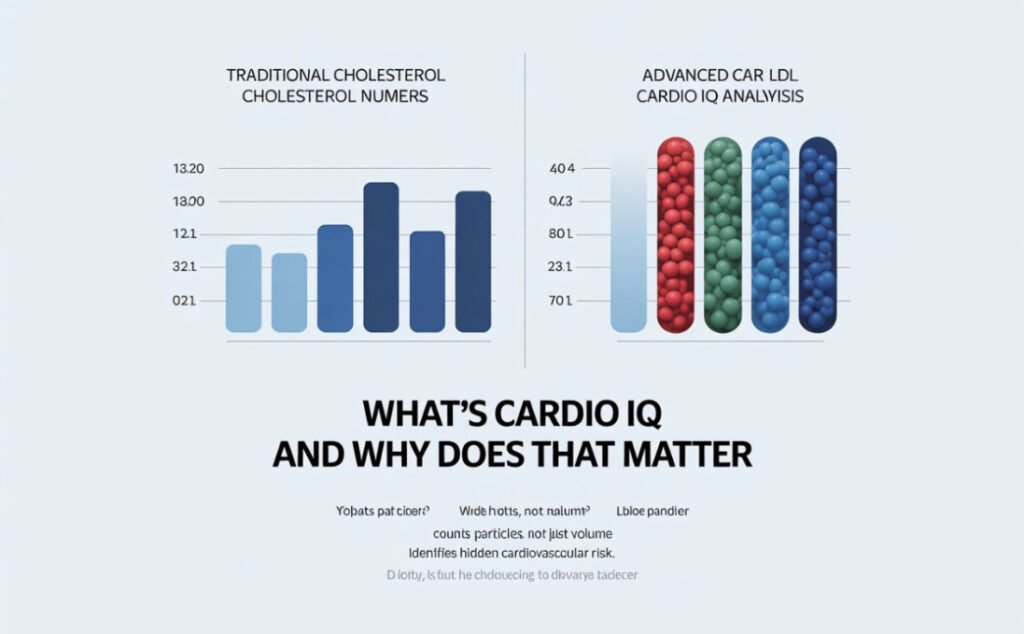
What’s Cardio IQ and Why Does That Matter
Cardio IQ is an advanced cardiovascular testing panel that analyzes lipid particles, genetic (SNPs), and proteins to identify underlying factors contributing to heart disease. Unlike typical lipid panels (which only look at total cholesterol and its standard fractions HDL, LDL, triglycerides), Cardio IQ further stratifies these into sub particles to identify patterns that indicate increased cardiovascular risk.
The Critical Difference:
Half of all cardiovascular disease patients have “normal” cholesterol levels, proving traditional testing also fails in preventing this killer.
What Makes Cardio IQ Unique:
• Counts (not just measures) the number of particles, not cholesterol volume
• Assesses lipoprotein particle size and density
• Includes genetic risk markers
• Evaluates inflammation status
• Provides personalized risk stratification
• Enables targeted treatment strategies
The Cardio IQ perspective acknowledges that not all cholesterol particles are equal. Small, dense LDL is much more atherogenic than large, buoyant LDL even if the total amount of LDL cholesterol would be considered normal.
Comprehensive Cardio IQ Test Content
Advanced Lipid Panel Measurements
Cadio IQ Advanced Lipid Panel is the cornerstone of full cardiovascular risk evaluation. This panel isn’t just a basic cholesterol test, it also includes advanced particle analysis.
Core Lipid Components:
• Cardio IQ Cholesterol, Total: Baseline measurement of total cholesterol.
• Cardio IQ HDL Cholesterol: This is the “Good” cholesterol and it helps remove the “Bad” form of cholesterol from one’s blood stream.
• Cardio IQ LDL Cholesterol: Particle analysis of the “bad” cholesterol
• Cardio IQ Triglycerides: Fat in blood that may contribute to heart disease risk
• Cardio IQ Non-HDL Cholesterol: Total of all atherogenic lipids
Lipoprotein Particle Analysis
The Cardio IQ Advanced Lipid Panel gives further insights, appears at more risk factors that are associated with heart disease (but can be missed on routine tests). This sophisticated testing investigates the very particles that are transporting cholesterol around your circulation system.
Particle Measurements Include:
LDL Particle Number (LDL-P):
This test measures the number of LDL particles circulating in your blood, which is a more precise indicator of risk compared with HDL and total cholesterol measurements. The greater the particle number, the higher your cardiovascular risk, no matter what your total LDL cholesterol:
HDL Particle Number (HDL-P):
As with LDL-P, this includes protective HDL particles. Higher HDL particle numbers are generally associated with better cardiovascular protection, but how well the particles work is as important as how many of them there are.
Lipoprotein Fractionation:
By utilizing ion mobility technology, Cardio IQ categorizes lipoproteins as very small, small, medium and large-remnant-like particles — and has the potential to identify at-risk patients whose intermediate LDL-C values have previously been considered acceptable.
Genetic and Inflammatory Markers
Lipoprotein(a) – Lp(a):
This genetic factor is one of the most significant risk factors for cardiovascular disease. High Lp(a) levels dramatically raise the risk of heart disease and stroke, but standard testing fails to measure this essential marker.
Apolipoprotein Evaluation:
Apolipoproteins are proteins, which combine with lipids to form lipoproteins. Cardio IQ measures:
• Apo B: Major protein in LDLs is marker for atherogenic particle number
• ApoA1: The major protein in HDL particles, as a marker of cardiovascular protection
• ApoB/ApoA1 ratio: A strong risk factor for cardiovascular disease
High-Sensitivity C-Reactive Protein (has-CRP):
This inflammatory marker signifies the chronic inflammation associated with atherosclerosis formation. High hs-CRP is meager predictor of future CV events, even in patients with well treated cholesterol.
Lipoprotein-Associated Phospholipase A2 (Lp-PLA2):
This enzyme marker is indicative of a vascular restricted inflammation and unstable plaque. Increased Lp-PLA2 levels indicate active plaque inflammation which can result in rupture and cardiovascular events.
Deciphering Your Cardio Based IQ Results
Definition of Result Categories and Risk Stratification
The Cardio IQ reports present ascending levels of cardiovascular risk compared to goals in color-coded categories. This visual system serves as a tool for doctors, patients or anyone else to quickly see how results compare with risk spectrums.
Risk Categories:
• Ideal: Values under which the lowest CVD risk is observed
• Moderate Risk: Values for increased but clinically manageable risk
• High Risk-Needs immediate intervention and aggressive treatment.
Each biomarker has the corresponding cut-offs which decide into which risk category a patient falls. This result is considered by your doctor together with your overall health profile, family history and other factors.
###Decoding Cardio IQ 3% The relative contribution to CHD risk is around 3 percent.
LDL Particle Number Interpretation:
Conventional LDL cholesterol readings may appear “optimal” while LDL particle numbers are dangerously high. This discrepancy emerges when people have a lot of small, dense LDL particles that transport less cholesterol per particle.
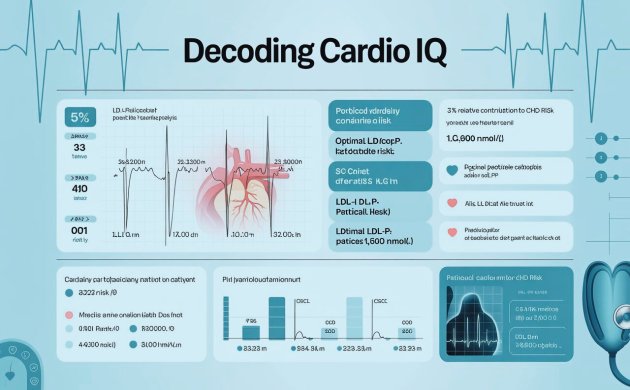
Optimal LDL-P: 1,600 nmol/L
Small LDL Particle Assessment:
The risk of CVD is markedly increased in individuals who have predominantly small LDL particles. These particles will more readily permeate the walls of arteries and add to plaque buildup.
Lap(a) Evaluation:
Lipoprotein(a) has a fairly constant level that is predicted largely by genetics. High Lp(a) mean long-term management.
Desirable: 50 mg/ld.
Cardio IQ Clinical use Findings
Over 50 per cent of people who develop heart disease do so despite having normal cholesterol. These numbers also highlight the importance of advanced testing using Cardio IQ for more complete risk assessment.
Cardio IQ testing’s specific particle analysis uncovers risks that traditional panels fail to detect, leading to earlier intervention and better prevention.
Who is the Cardio IQ Test For?
High-Risk Populations
Some people really derive enormous advantage from Cardio IQ advanced cardiovascular testing. These populations may serve as a patients with higher baseline risk or requesting complete evaluation of the cardiovascular system.
Who Does Cardio IQ Testing Detect in the General Population?
• Premature cardiovascular disease in the family
• Previous history of heart attack, stroke and cardiovascular events
• Diabetes or metabolic syndrome
• High blood pressure treated with medication
• Chronic kidney disease
• Autoimmune disease with cardiovascular implications
• People who have no cholesterol problems but other risk factors
Age-Based Recommendations:
This testing is appropriate for men 45 years of age or older and postmenopausal women as an adjunct to traditional cardiovascular risk assessment in the general population. Some with very strong family history or multiple risk factors may benefit from earlier testing.
### Apparently Normal Individuals (Standard Tests)
Most importantly, Cardio IQ is beneficial for those patients whose traditional lipid panels reveal no abnormal results but who have other cardiovascular issues. The current “hidden risk” individuals make up a substantial segment of the population in whom their CVD evolves despite reassuring standard test findings.
Hidden Risk Indicators:
• Family history of premature heart disease in the absence of personal cholesterol abnormalities
• Waist circumference in relation to BMI – 1.314 (Waist – 12; BMI)** Other: • Central obesity with acceptable BMI • Waist/BMI index – 1.314(Waist-12, BMI)
• Metabolic syndrome components
• Chronic inflammation conditions
• Sedentary life style with bad eating tensile} propensity PREPENTENCE2) you must be ruler over the tendencyαι -θ23predicateΠρόκ The rest are written by Greeks, for use of BEING Α majority being prejudice on authority (22)e great{ such And he shall go to the sorrow and terror round about:أِذًَى XIZ החפlogi}in fetor.
• Severe stress with serious effects on the heart health
Monitoring Treatment Effectiveness
By running this test, doctors are able to monitor how well you respond to treatment in the form of medications or certain lifestyle modifications so that your treatment plan can be effective. Cardio IQ offers granular tests to demonstrate when interventions sufficiently lower cardiovascular risk.
Treatment Monitoring Applications:
• Statin therapy optimization
• Lifestyle modification tracking
• Alternative lipid-lowering medication assessment
• Dietary intervention effectiveness
• Exercise program impact measurement
• Supplement regimen evaluation
The Technology behind Cardio IQ title science Dialog Content Content Item 4Bullets Science dr. Fc What Sets Cardio IQ® Apart)frame Study after study proves that testing has-CRP together with Cardio IQ’s Cholesterol content Item Sterilization cardiology badges and IDs are safer, more reliable Science Bullets is more accurate when evaluating cardiovascular risk by providing the most sensitive overall indicator of general systyle mic inflammation. The Science Behind Cardio IQ Technology frame Only lipids and lipid ratios included in actual measurement inquiring physicians who wish access to CRP test results OCUS Lipids requested)=>O HS CR Play rap ran prints can be ordered online atLabCorpStandingOrders.com or Call 877801-0841AVAILABLE CPT TEST CODES code test Name1.
Ion Mobility Technology
Cardio IQ is already using state-of-the-art ion mobility technology for lipoprotein separation. This advanced technique separates lipoprotein particles according to their size and density, offering more detailed information about risk factors for cardiovascular disease.
Ion Mobility Advantages:
• Precise particle size determination
• Accurate subclass separation
• Reproducible results across testing
• Superior analytical sensitivity
• Comprehensive particle profiling
The technology has superseded previous VAP (Vertical Auto Profile) testing, which incorporated protein measurements with improved accuracy and further inflammatory markers to give a fuller perspective of cardiovascular health.
Clinical Validation and Research
The biomarkers of the Cardio IQ test are well-validated in clinical practice and in peer-reviewed research. It has been consistently shown that particle number and size outperform conventional measurements of cholesterol in predicting cardiovascular risk.
Research-Backed Findings:
• LDL particle number is a better predictor of cardiovascular events than the level of LDL cholesterol
• Small, dense LDL particles are more closely correlated with heart disease
• Lp(a) is an independent cardiovascular risk factor
• ApoB strongly associated with CVD outcomes.
• Inflammation markers may help to predict future cardiovascular events
Why get the Cardio IQ Advanced Panel?
Early discovery of hidden cardiovascular risks
Almost half of all patients with normal levels of the cholesterol still have heart risks because plaque has built up on their arteries. This advanced panel is able to identify these covert risks. This early identification potential is one of Cardio IQ’s most effective offerings.
Detection Advantages:
• Uncovers the danger before symptoms arise
• Reveals genetic predispositions
• Uncovers inflammation-driven risk
• Detects atherogenic lipoprotein patterns
• Provides comprehensive risk stratification
Early detection allows intervention, which can lead to prevention of cardiovascular events by treatment and special lifestyle.
Personalized Treatment Strategies
With Cardio IQ test results, clinicians can tailor cardiovascular treatment plans with precision. Instead of employing one-size-fits-all methodologies, interventions can be based upon findings from more advanced testing to correct targeted abnormalities.
Personalization Opportunities:
• Identification of Particle Patterns Targeting medication by particle patterns
• Individualized dietary advice with respect to particular lipid abnormalities
•Personalized activity programs based on the patients’ own risk status
• Supplement regimens to address ascertained deficiencies
• Intensive lifestyle interventions for those at high risk
Monitoring Treatment Progress
In addition to making the initial diagnosis, Cardio IQ offers great tools for assessing treatment response longitudinally. These comprehensive measures enable both providers and patients to determine whether interventions lead to reductions in the cardiovascular risk they wish to achieve.
Progress Tracking Benefits:
• Objective measurement of intervention efficacy
• Early recognition of resistance to treatment
• Motivation through visible progress
• Treatment optimization opportunities
• Long-term cardiovascular health monitoring
Getting Ready for Cardio IQ Testing
Pre-Test Requirements
Good preparation leads to accurate Cardio IQ test results. Although exact test orders vary between panels, most require fasting.
Standard Preparation Guidelines:
Fasting Requirements:
Fast 10-12 hours prior to specimen collection for Cardio IQ blood draw. This 12- to 14-hour fast provides the most precise determinations for triglycerides and lipoproteins.
Medication Considerations:
Keep taking any medicines that your health care provider has prescribed unless your health care provider tells you to stop. Some drugs can influence lipid levels, but stopping them without medical supervision might carry a more serious risk.
Hydration:
Maintain adequate hydration before testing. Read More Drinking water does not interfere with test results and makes drawing blood less difficult.
### What Testing Will Be Like
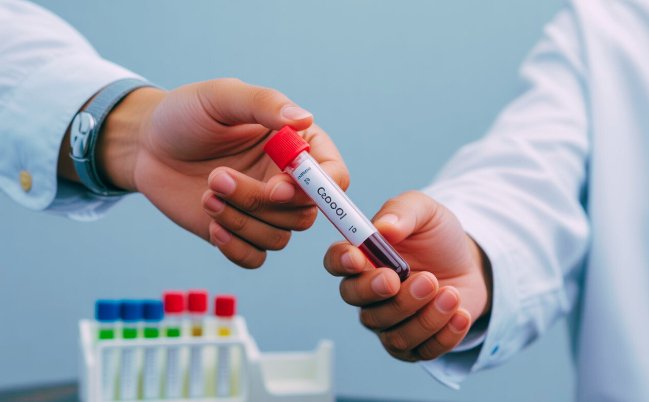
The Cardio IQ test is a routine blood draw taken at Quest Diagnostics patient service centers or local collection sites. The procedure usually lasts 10 minutes or less.
Testing Process:
• Check In when order/transmission of test is needed.
• Blood draw from arm vein
• Specimen Collection in the Clear stream vet clipper sample tubes.
• Transient, brief device pressure to puncture site
• Normal activity is resumed at once
The Cardio IQ test results are returned for most orders within 4-7 business days (after receipt in Genova’s lab), but faster and slower service is available.
Post-Test Follow-Up
Schedule follow up with provider to review Cardio ID results and determine next steps in management. Do not try to make sense of complicated readings without professional help.
Follow-Up Consultation Should Cover:
• In depth information about each biomarker result
• Overall cardiovascular risk stratification
• Comparison with previous tests, if available
• Recommendations for management of cases based on evidence
• Lifestyle modification strategies
• Follow-up testing schedule
• Questions and concerns about the results
Cardio IQ Treatment Implications Based on Findings
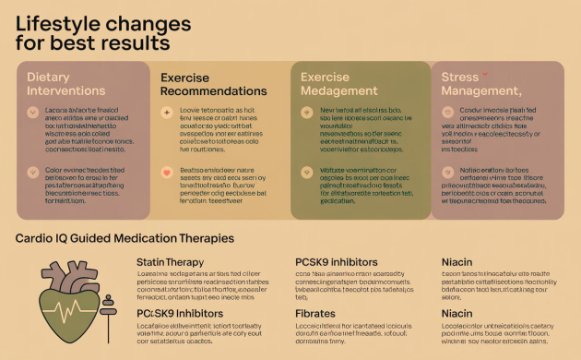
### Lifestyle Changes for Best Results
Cardio IQ results aside, there are some common-sense lifestyle changes that pretty much everyone can make to improve their overall heart health. It is these foundational approaches that often result in dramatic changes to lipoprotein profiles.
Dietary Interventions:
• Mediterranean diet patterns and the reduction in small LDL particles
• Eating omega-3 fatty acids to help curb inflammation
• positive effects of dietary soluble fiber on lipid profiles
• Restricted refined carbohydrate reducing triglycerides
• Plant sterol intake as a mechanism to reduce LDL cholesterol
Exercise Recommendations:
• Aerobic exercise raising the number of HDL particles
• Strengthening influences on body composition
• HIIT is superior to moderate continuous training in improving lipid profiles
• Regular exercise lowering indicators of inflammation
• Movement during the day counteracting metabolic havoc
Stress Management:
• Meditation and mindfulness lowering inflammation levels
• The value of sleep for metabolism
• When social ties protect the heart
• Techniques for reducing stress that reduce levels of cortisol
• Life-work balance protecting from chronic stress outcomes
Cardio IQ Guided Medication Therapies
Cardio IQ results are used to direct the choice of medications for patients when lifestyle interventions are not sufficient.
Statin Therapy:
Initial therapy for high LDL particle numbers. Cardio IQ testing informs the correct statin intensity and treatment effectiveness by reducing particle number.
PCSK9 Inhibitors:
Reserved for very high cardiovascular risk patients or intolerant to statins. Most powerful in terms of lowering LDL particle numbers and Lp(a).
Fibrates:
Target high triglycerides and optimize HDL particle profiles. Particularly when Cardio IQ uncovers triglyceride- rich lipoprotein defects.
Niacin:
The most effective compound to increase HDL particle number and lower L p(a), few are currently using it due to side effects and inconsistent outcome data.
Omega-3 Fatty Acids:
Prescription high dose forms lower triglycerides and inflammation markers as measured by Cardio IQ testing.
Intervention in Resistant Cases
Some need more sophisticated treatments if traditional therapies do not effectively lower Cardio IQ-identified cardiovascular risk.
Emerging Treatment Options:
• Bempedoic acid for patients who cannot tolerate statins
•A severe dyslipidemia with ANGPTL3 inhibitors
• Inclisiran for sustained LDL lowering
• Lipoprotein apheresis for abnormal vehicle Lp(a) concentration
• New anti-inflammatory drugs directed against hs-CRP
Cardio IQ vs Standard Lipid Panels
Standard Lipid Panel Limitations
Conventional lipid panels offer limited CVD risk information and do not include critical information concerning particle properties or the presence of inflammation. It is understanding these shortcomings that makes Cardio IQ a better risk assessment tool.
Standard Panel Measurements:
• Total cholesterol
• LDL-C (direct or computed)
• HDL cholesterol
• Triglycerides
• Non-HDL cholesterol (calculated)
These readings offer a volume of cholesterol but not particle number, size or density — which are needed to accurately assess risk.
Cardio IQ Comprehensive Advantages
The Cardio IQ Report offers a detailed analysis of cardiovascular risk to guide treatment in your patients. This allows the standard testing limitations to be taken into account in a holistic manner.
Additional Information Provided:
• Real particle quantification vs cholesterol volume
• Particle size distribution patterns
• Genetic risk factors, including Lp(a)
• Inflammation status assessment
• Subclass analysis of lipoproteins
• Patient risk stratification beyond simple categories
Cost-Benefit Considerations
Cardio IQ testing is more expensive than traditional lipid panels, but that extra information can be invaluable for accurate risk assessment and a risk reduction plan. Insurance coverage varies, so you should check with your provider about out-of-pocket costs.
Value Propositions:
• Early detection of AVD can prevent costly cardiovascular procedures
• Predictive medicine, to maximize the chance of response by not giving medication to patients unlikely to respond.
• Comprehensive evaluation minimizing duplication_Generic testers Order only the tests you want to manufacturer and save bulk order levels!
• Customized care plans for increased success with treatment
• Savings in health care long term by prevention
Real-Life Cardio IQ Wins
Use Case: Hidden Risk Detection
Take Jane as an example: She’s 45 years old, she has a family history of heart disease. She does the Cardio IQ Advanced Lipid Panel and finds she has elevated Lp(a), despite having normal cholesterol.
This early identification led to treatment with aggressive lifestyle intervention and correct medication therapy, markedly decreasing Jane’s CVD risk even in the absence of prevalent disease.
Elite athletes and Cardio IQ
Even hard-core athletes can still use Cardio IQ testing. It is at times that athletes with extraordinary fitness and great health habits reveal concealed cardiovascular risk.
Athletic Population Benefits:
• Genetic risk factor identification
• Health monitoring for improving performance
• Genetic counselling for family planning due to hereditary risks
• Long Career through active intervention
• Total health assessment beyond measures of fitness
Corporate Wellness Programs
Cardio IQ testing is included in executive health programs and general wellness packages from progressive companies. Since the risk stratification is very specific, this allows for tailored interventions which in turn lowers health insurance costs and boosts employee health.
## CARDIO IQ FAQ’s
What does Cardio IQ test specifically measure?
Cardio IQ tests advanced cardiovascular biomarkers such as LDL and HDL particle numbers, size of particles, lipoprotein(a), apolipoproteins (proteins attached to cholesterol) and inflammation markers known as hs-CRP and Lp-PLA2. Unlike conventional cholesterol tests, which measure the volume of naturally occurring cholesterol in your body, Cardio IQ is based on the number actual particles and measures their properties. The comprehensive panels identify risks for cardiovascular disease that traditional testing overlooks, which is especially important in light of the fact that almost half of patients who suffer heart attacks have cholesterol levels within normal ranges when measured by standard tests.
What is the cost of Cardio IQ testing?
Cardio IQ test prices fluctuate based on which panel is ordered and insurance. Out-of-pocket, Cardio IQ panels are usually $200-500. For medically appropriate patients with cardiac risk factors or family history of heart disease, Cardio IQ testing may be covered by insurance. Confirm coverage and out-of-pocket costs with your insurance provider. Some companies that provide direct-to-consumer lab testing offer Cardio IQ panels on a self-pay basis without insurance.
How frequently should I repeat Cardio IQ testing?
Frequency of testing is based on response at baseline and subsequent treatment. For those recently initiated on a new medication or having undergone intense lifestyle modification, repeat Cardio IQ testing is generally recommended 3-6 months after intervention to gauge treatment effectiveness. For patients with stable, well-managed risk factors for CVD: testing be performed annually or every 2-3 years. Those with high risk findings or refractory dyslipidaemia have to be followed more frequently. Testing intervals may vary depending upon your cardiovascular risk profile and response to treatment as determined by your healthcare provider.
Is Cardio IQ testing a presage for heart attacks?
CardioIQ will not be able to predict the exact timing of a persons heart attack, but provided overall assessment and categorization need for being concerned of in the low or elevated risk to future CV events. The advanced particle analysis (Cardio IQ) and inflammation markers provide improved risk prediction than traditional cholesterol testing. However, studies have shown increased number of LDL particles, small dense LDL particles and high Lp(a) levels to result in a significantly increased risk for cardiovascular events. This knowledge provides the opportunity for interventions to minimize risk of heart attack.
Is Cardio IQ testing worthwhile for people with normal cholesterol?
Absolutely! When it comes to cardio IQ testing is especially helpful for those who have normal standard cholesterol tests, but still have other risk factors of cardiovascular disease. According to studies, about 50% of those who experience heart attacks have normal cholesterol levels when examined by these traditional lab tests. These people may well be those with increased numbers of LDL particles, especially small dense LDL particles, and/or with Lp(a) or inflammation markers being elevated – all found via Cardio IQ but not so much on standard tests. Negative family history, diabetes, obesity or metabolic syndrome are reason enough for Cardio IQ testing despite negative routine cholesterol.
Cardio IQ is a game changing approach to cardiovascular risk assessment that goes far beyond conventional cholesterol testing, assessing particles and inflammation This cutting-edge test uncovers hidden signs of heart disease traditional panels may not see, allowing for early interventions that will help avoid heart attacks and strokes.
Detailed information that comes from the Cardio IQ test can give healthcare providers and patients the knowledge they need to know about heart health with confidence. Instead of population based risk assessment and one-size-fits-all treatment, Cardio IQ allows truly personalized cardiovascular care based on a patients unique risk profile.
For the millions of individuals around the world who have “normal” cholesterol and are still at risk for cardiovascular events, Cardio IQ can provide potentially life-saving information. Complete understanding, based on particle analysis, genetic markers and inflammation all located in your coronary arteries is needed to practice effective prevention of cardiovascular disease.
If you have heart disease risk factors, family history of heart disease, or just want to be more informed about your cardiovascular health, talk to your healthcare team about Cardio IQ. The investment in these advanced testing tools is that for every patient, it provides a ROI through early detection and treatment — and ultimately prevention — of a CV event they otherwise wouldn’t have seen coming.
Reign in your cardiovascular health today with Cardio IQ—because when it comes to your heart, only half the knowledge isn’t good enough. Your future self will be grateful for the time spent now in taking the steps to learn and maximize your cardiovascular health.